Après vs Derrière
 The prepositions après and derrière have somewhat similar meanings, which of course means that students sometimes get them confused. Learn the difference between après and derrière to put all of this confusion behind you.
 Grammaire
Learn about French grammar: parts of speech, negation, verb conjugations, and a whole lot more.
 French Workbook for Dummies
Learn and practice with my fun French workbook.
A1 grammar | A2 grammar | B1 grammar | B2 grammar | C1 grammar
Proficiency Test: Find Your Level
| Adjectives | Adverbs | |
| Articles | Conjunctions | |
| Nouns | Prepositions | |
| Pronouns | Verbs |
The prepositions après and derrière have somewhat similar meanings, which of course means that students sometimes get them confused. Learn the difference between après and derrière to put all of this confusion behind you. A2 - Low-Intermediate French • prepositions
 The French verb arriver usually means "to arrive" or "to happen." It's a regular -er verb that requires être as its auxiliary verb in compound tenses/moods.
  There are three types of French articles (definite, indefinite, and partitive), and it's not always easy to know which one you need. Here's a detailed comparison to help you decide.
 A2 - Low-Intermediate French • articles
One of the eight parts of speech, an article is a word that modifies a noun in a particular way, by stating whether the noun is specific, unspecific, or partial. There are three types of French articles and they all agree in gender and number with the nouns they modify.
A1 - Beginning French • articles
 Despite their tiny size, French articles are an immensely important part of speech. They introduce and modify nouns, providing key information about the purpose of those nouns - as well as their gender and number. Today’s issue of Lawless French à fond takes an in-depth look at the similarities and differences between French articles, and the tricky aspects of using them correctly.
  Auxiliary verbs are also known as helping verbs, because they help form compound conjugations. The key thing to remember about compound conjugations is that it's the auxiliary verb which conjugates for the required tense or mood; the main verb is always a past participle.
 A2 - Low-Intermediate French • conjugation lessons • lesson plans • tenses moods voices
 The prepositions avant and devant have somewhat similar meanings, which of course means that students sometimes get them confused. Learn the difference between avant and devant to get in front of any potential confusion.
 A2 - Low-Intermediate French • prepositions
 The preposition avec is used similarly to its English equivalent "with," but with a few differences.
 A1 - Beginning French • adverbs • prepositions
 Inversion is an essential verbal structure, but because it's formal, it can make your French sound overly fussy. So outside of formal situations like job interviews and journalism, you need to know your options. Here are the most common ways to use inversion and grammatically correct ways to avoid it.
B2 - Upper-Intermediate French • informalities
 Although the subjunctive is commonly used in French, there are numerous ways to avoid it, with varying meaning changes. (This doesn't mean you don't need to know how to use the subjunctive, just that there are times when an alternative is acceptable.)
 B2 - Upper-Intermediate French • tenses moods voices
 Avoir is one of the two most important French verbs and has irregular conjugations in just about every tense and mood. Avoir literally means "to have" but also serves an an auxiliary verb and is found in many idiomatic expressions.
 French has two auxiliary verbs (aka helping verbs): avoir and être. That means one or the other of these is the opening salvo in every compound verb conjugation, such as the passé composé and the futur antérieur.

 The French words bon and bien can be tricky for French students because they both belong to three different parts of speech (adjectives, adverbs, nouns) and have similar meanings. This is a good lesson that will get you well on your way to understanding the difference.
 adjectives • adverbs • nouns
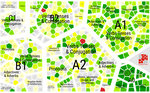 Visualize your French progress with the PwLF Brainmap. The color-coded overview shows your strengths and weaknesses by level and topic, and you can drill down to access individual lessons. Prove your mastery by turning the whole map green!
 A1 - Beginning French • A2 - Low-Intermediate French • B1 - Intermediate French • B2 - Upper-Intermediate French • C1 - Advanced French


 In English, we say that the vowels are "a, e, i, o, u, and sometimes y." The last couple of words hint at one of the keys to understanding pronunciation: a vowel is not so much a letter as the sound represented by a letter or combination of letters.

 Practice is the key to improving your French, and just 15 minutes a day on some kind of French activity can make a huge difference. Check out these ideas and draw up your own schedule.
 Of the four language skills, many people find that speaking is the most difficult. Here are tips and resources to help you overcome these obstacles in order to practice French as much as you like.
Bonjour !
Lawless French is a free website.
Please disable your ad-blocker
or
donate to support my work.
BONUS
Donate US$5 / month to unlock
le Mot du jour.
