
Changer le réfléchi en passif
 |
|
| Share / Tweet / Pin Me! | |
Reflexive verbs indicate that their subjects are performing some action on themselves, but what about when the subject doesn’t matter so much as the action itself? You have two options:
1. Use the passive reflexive (e.g., ça se voit)
2. Convert the sentence into the passive voice – but in doing so, you have to lose the reflexive.
Par exemple…
| Reflexive | Passive | |
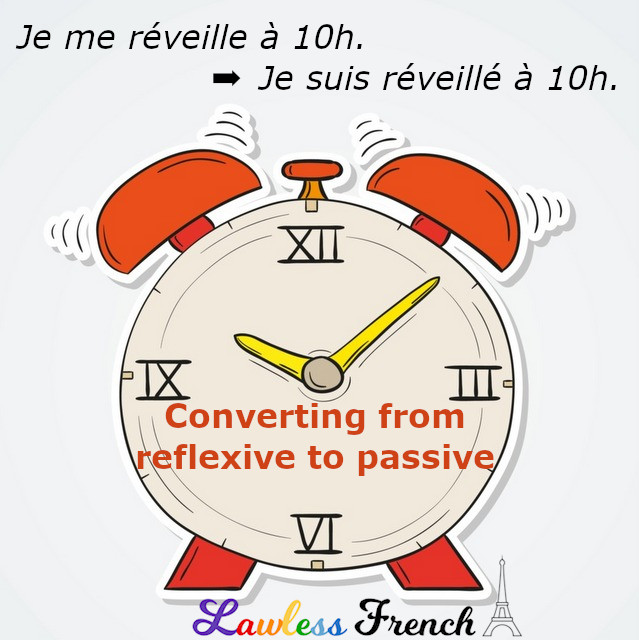
| Je me réveille à 10h. | Je suis réveillé à 10 h. | |
| I wake up at 10 am. | I am woken up at 10 am. | |
| Il se rase le matin. | Il est rasé le matin. | |
| He shaves in the morning. | He gets shaved in the morning. |
How to change reflexive to passive
First, remove the reflexive pronoun.
Then consider the tense used in the original and replace it with the equivalent passive voice:
- conjugate être into that tense or mood – in the above examples, it’s in the present
- add the past participle of the main verb
- make the past participle agree with the subject
Reflexive to passive in other tenses and moods
| Reflexive | Passive | ||
| Passé composé | Je me suis réveillé | J’ai été réveillé | |
| Imperfect | Je me réveillais | J’étais réveillé | |
| Pluperfect | Je m’étais réveillé | J’avais été réveillé | |
| Future | Je me réveillerai | Je serai réveillé | |
| Conditional | Je me réveillerais | Je serais réveillé | |
| Subjunctive | … que je me réveille | … que je sois réveillé |
Essentially pronominal verbs cannot be made passive; you have to rewrite it some other way.
Par exemple…
He is remembered. – On se souvient de lui.
Related lessons
Share / Tweet / Pin Me!

 This free website is created with love and a great deal of work. If you love it, please consider making a
  Inverting subjects and verbs is easy enough – vous voyez => voyez-vous, but where do object, adverbial, and reflexive pronouns go? And what about negation? Take a look at this lesson to learn about all the possibilities.
 Magnetic poetry is a fun little tool you can use to learn and practice French. 500 magnets with words and parts of words help you to express yourself in a unique and creative way.


 There’s no secret recipe for fluency; indeed, it’s difficult to even find consensus on what “fluency” actually means. Is it the ability to have a conversation, or language proficiency equivalent to that of a native speaker?