
 |
|
| Share / Tweet / Pin Me! | |
French prepositions
The prepositions à and de are found in many verbal constructions that look very similar, but the choice of preposition makes all the difference.
À and de with verbs
The prepositions à and de can be particularly challenging when it comes to using them with verbs.
1) à ≠ de
These nine verbs have different meanings depending on which preposition follows.
| décider qqun à | to persuade, convince | décider de | to decide (to do) | |
| demander à qqun | to ask (for permission) | demander de | to ask (to do) | |
| jouer à | to play a game or sport | jouer de | to play an instrument | |
| manquer à qqun | to miss (someone) | manquer de | to neglect (to do) | |
| parler à qqun | to talk to | parler de | to talk about | |
| penser à | to think about (imagine) | penser de | to think about (opinion) | |
| profiter à | to benefit | profiter de | to make the most of | |
| tenir à | to care about | tenir de | to take after (someone) | |
| venir à | to happen to | venir de | to have just (done) |
Par exemple…
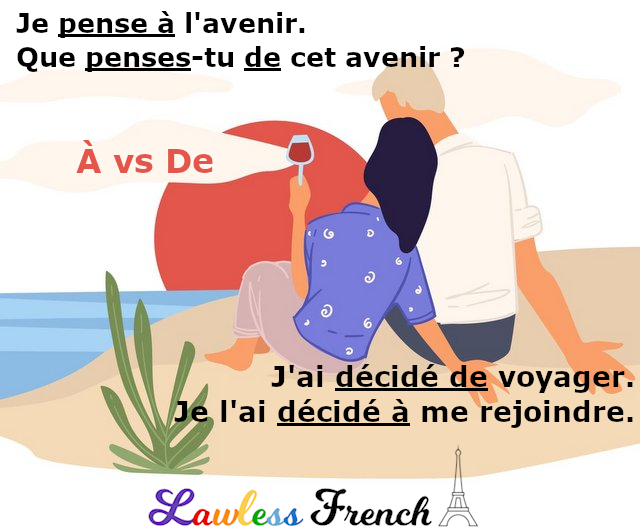
| J’ai décidé de voyager. | I decided to travel. | |
| J’ai décidé ma sœur à me rejoindre. | I convinced my sister to join me. |
2) à + de
Nine verbs can use à and de together in the following construction:
verb + à + quelqu’un + de + infinitive
For eight of these verbs, à indicates who is to do something, while de precedes whatever that something is.
| à qqun | de faire | ||||
| commander | to order | someone | to do | something | |
| conseiller | to advise | " | " | ||
| défendre | to forbid | " | " | ||
| demander | to ask | " | " | ||
| dire | to tell | " | " | ||
| interdire | to forbid | " | " | ||
| ordonner | to order | " | " | ||
| permettre | to allow | " | " | ||
So for the above verbs, the "someone" after à (or replaced by an indirect object pronoun) is the person who is supposed to perform the action after de.
Par exemple…
| Il a conseillé à Ana de partir immédiatement. | He advised Ana to leave immediately. | |
| Je te dis de manger les épinards. | I’m telling you to eat the spinach. |
The ninth verb, promettre, is a little different: the person doing the action after de is the same as the subject. À precedes the person who is promised that action.
Par exemple…
| Elle a promis à Paul de dire la vérité. | She promised Paul that she’d tell the truth. | |
| Je te promets de finir mes devoirs. | I promise you I’ll finish my homework. |
3) à = de
After these verbs, either preposition can be used with no real difference in meaning.
| commencer à commencer de |
to start (doing) | |
| continuer à continuer de |
to continue (doing) | |
| prendre garde à prendre garde de |
to be careful to | |
| rêver à rêver de |
to dream of, about |
À and de in phrases
A few phrases look similar but have different meanings depending on the preposition.
| à côté | nearby, next to | de côté | sideways | |
| à côté de | next to, beside | du côté de | from (direction) | |
| à la hauteur | at the level | [un mètre] de hauteur | [one meter] tall |
À vs de Quizzes
Think you’ve got it? Test yourself on verbs with à and de with these fill-in-the-blanks exercises:
Note: You must be logged into your Progress with Lawless French account to take these tests. If you don’t have one, sign up – it’s free!
Related lessons
- All about à | Verbs that require à
- All about de | Verbs that require de
- À vs de after adjectives
- Infinitives
Share / Tweet / Pin Me!
 This free website is created with love and a great deal of work. If you love it, please consider making a
  Practice is the key to improving your French, and just 15 minutes a day on some kind of French activity can make a huge difference. Check out these ideas and draw up your own schedule.
 Of the four language skills, many people find that speaking is the most difficult. Here are tips and resources to help you overcome these obstacles in order to practice French as much as you like.
 Jouer is a regular -er French verb that can be a bit confusing when it comes time to decide which preposition should follow. Here’s everything you need to know.

 The French lessons and comprehension exercises on this site are ranked according to the Common European Framework of Reference for Languages (CEFR), which describes six levels of language proficiency.