 |
|
| Share / Tweet / Pin Me! | |
Agreeable French Expression
| Meaning | absolutely, exactly, totally | |
| Register | normal, informal | |
| Pronunciation |  |
[too tah feh] |
| IPA | [tu ta fɛ] | |
Usage notes: The French expression tout à fait is used to emphatically and enthusiastically agree with a statement.
It’s also used, informally, when a simple oui would suffice – this usage is criticized.
Par exemple…
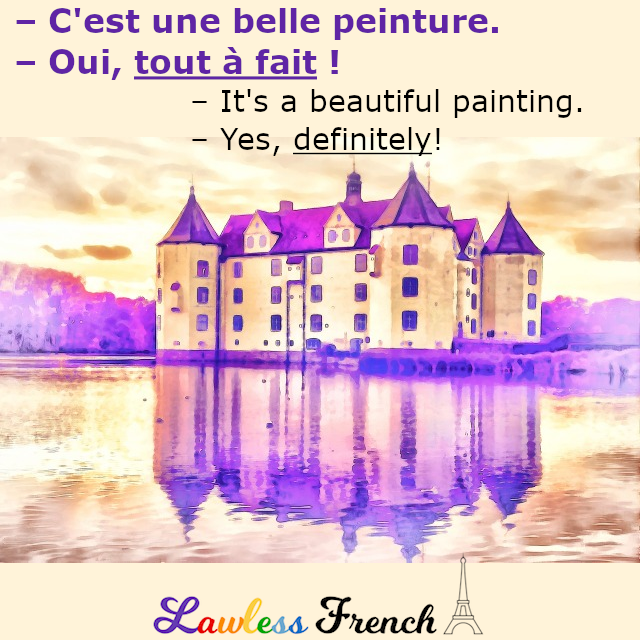
| – C’est une belle peinture. – Oui, tout à fait ! |
– It’s a beautiful painting. – Yes, definitely! |
|
| – Il a pris une bonne décision. – Tout à fait ! |
– He made a good decision. – Absolutely! |
Synonyms
- absolument – absolutely
- bien sûr – of course
- certainement – certainly
- en effet – indeed
- exactement – exactly
- je suis d’accord – I agree
- oui – yes
- voilà – that’s right, exactly
Tout à fait can also be used as an intensifier.
Par exemple…
| Elle est tout à fait charmante. | It’s altogether charming. | |
| Tu as tout à fait raison. | You’re absolutely right. |
Synonyms
- complètement – completely
- totalement – totally
- vraiment – really
informal - carrément – definitely
- drôlement – really, awfully
- rudement – awfully, terribly
- sacrément – really, damned
- vachement – really
Pas tout à fait
Pas tout à fait means “not exactly” or “not quite”:
Par exemple…
| – Tout le monde est prêt ? – Pas tout à fait. |
– Everyone ready? – Not quite. |
|
| Cela n’est pas tout à fait ce à quoi je m’attendais. | That’s not exactly what I was expecting. |
Related lessons
Share / Tweet / Pin Me!

 This free website is created with love and a great deal of work. If you love it, please consider making a

 The mountain of French verb conjugations you have to learn can be overwhelming – even just in the classroom where you have plenty of time to think about the correct response. Once you start talking to people in the real world, trying to figure out the appropriate verb conjugation can leave you speechless – literally. So what’s the solution? Learn, then practice, practice, practice!
 Inverting subjects and verbs is easy enough – vous voyez => voyez-vous, but where do object, adverbial, and reflexive pronouns go? And what about negation? Take a look at this lesson to learn about all the possibilities.
 Magnetic poetry is a fun little tool you can use to learn and practice French. 500 magnets with words and parts of words help you to express yourself in a unique and creative way.