
 |
|
| Share / Tweet / Pin Me! | |
French Expression
| Meaning | to forgive and forget, let bygones be bygones, wipe the slate clean | |
| Literally | to pass the sponge | |
| Register | normal | |
| Pronunciation |  |
[pah say lay po(n)zh] |
| IPA | [pa se le pɔ̃ʒ] | |
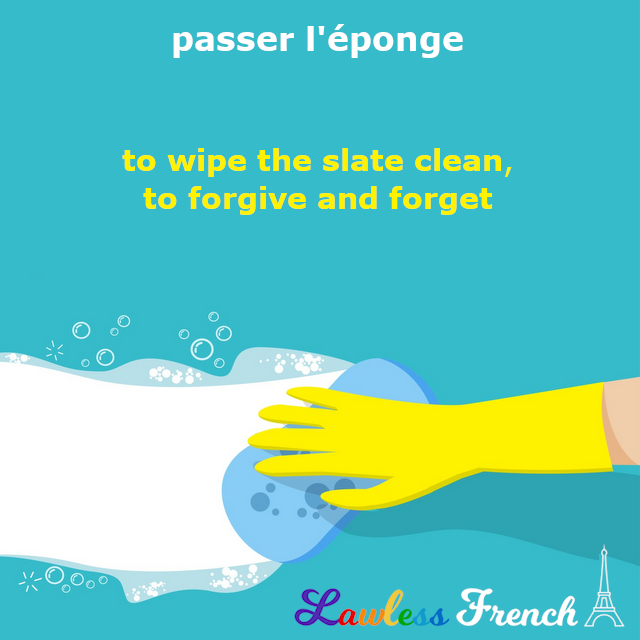
Usage notes: The French phrase passer l’éponge literally means to clean something by wiping a sponge over it. This isn’t a million miles away from the idiomatic meaning of wiping the slate clean: to forgive some offense and let bygones be bygones.
Par exemple…
| Je suis vraiment désolé, on peut passer l’éponge ? | I’m really sorry, can we wipe the slate clean? | |
| Bien qu’il m’ait insulté, j’ai passé l’éponge. | Even though he insulted me, I forgave him. |
Note that the helping verb in the second example is avoir, not être, due to the direct object éponge.
Synonyms
- excuser
- oublier
- pardonner
- recommencer à zéro
- repartir à neuf
- repartir à zéro
- reprendre à zéro
Related lessons
Share / Tweet / Pin Me!

 This free website is created with love and a great deal of work. If you love it, please consider making a


 There’s no secret recipe for fluency; indeed, it’s difficult to even find consensus on what “fluency” actually means. Is it the ability to have a conversation, or language proficiency equivalent to that of a native speaker?
 You probably know that 14 July is Bastille Day, but do you know what it’s called in French? (Hint, it’s not “jour de Bastille.”) Do you know the history behind Bastille Day, or how it’s celebrated in France? This page has links to everything you could possibly want to know.