
 |
|
| Share / Tweet / Pin Me! | |
French Expression
| Meaning | all age groups combined | |
| Register | normal | |
| Pronunciation |  |
[toot (eu) tra(n)sh dahzh ko(n) fo(n) doo] |
| IPA | [tutə trãʃ daʒ kɔ̃ fɔ̃ dy] | |
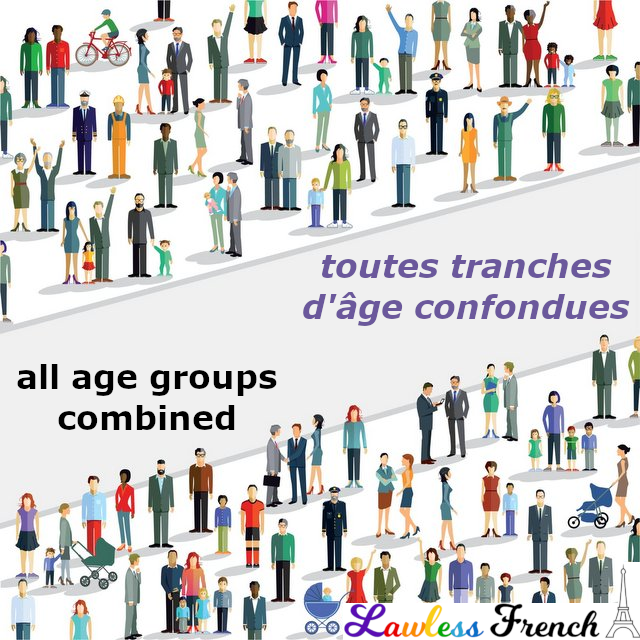
Usage notes: The expression toutes tranches d’âge confondues combines people of all ages into a single group. It can be general, referring to literally all ages, or it can be used within a subset, such as children of all ages. It has a slightly formal nuance and so tends to be used in documentation and statistics more than in everyday language.
Par exemple…
| Le taux de réussite à l’examen, toutes tranches d’âge confondues, est de 87 %. | The exam pass rate for all age groups combined is 87%. | |
| Le joueur le plus rapide du club, toutes tranches d’âge confondues, court 100 m en 13,4 secondes. | The club’s fastest runner, regardless of age group, runs 100 meters in 13.4 seconds. | |
| Toutes tranches d’âge confondues, la dépense moyenne au festival est de 6 € 35. | Across all age groups, the average spend at the festival is €6.35. |
Similar but not synonymous expression: toutes les tranches d’âge
Literally, "all age groups," toutes les tranches d’âge considers each age group as a separate entity. This expression is more casual and is commonly found in everyday French.
Par exemple…
| L’école propose des activités adaptées à toutes les tranches d’âge : maternelle, primaire, collège, lycée. | The school offers activities adapted for each age group: preschool, elementary, middle, and high school. | |
| Le club organise des tournois pour toutes les tranches d’âge : enfants, adolescents, adultes. | The club organizes tournaments for all age groups: children, teens, adults. |
Toutes … confondues can also be used with other nouns: toutes compétitions confondues (across all competitions), toutes entreprises confondues (all businesses combined), etc.
Grammar time!
Confondues is the feminine plural form of the past participle confondu, from the verb confondre (to confuse, mix up).
Related lessons
Share / Tweet / Pin Me!

 This free website is created with love and a great deal of work. If you love it, please consider making a


 There’s no secret recipe for fluency; indeed, it’s difficult to even find consensus on what “fluency” actually means. Is it the ability to have a conversation, or language proficiency equivalent to that of a native speaker?
 You probably know that 14 July is Bastille Day, but do you know what it’s called in French? (Hint, it’s not “jour de Bastille.”) Do you know the history behind Bastille Day, or how it’s celebrated in France? This page has links to everything you could possibly want to know.