
 |
|
| Share / Tweet / Pin Me! | |
Figure de style
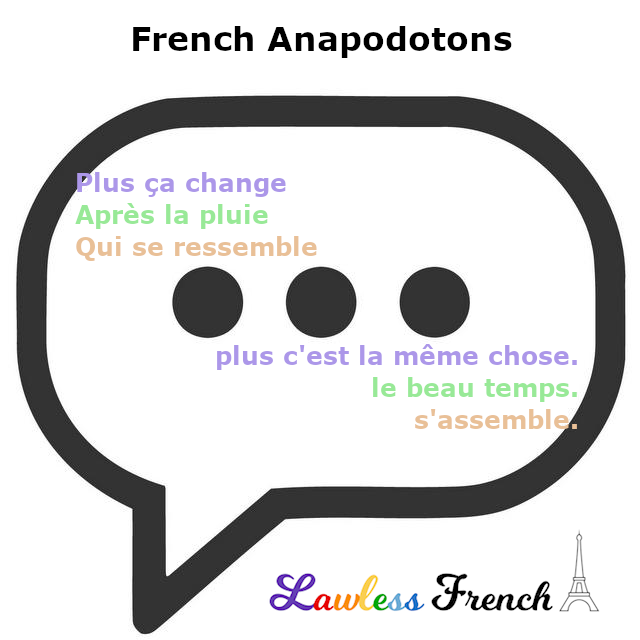
An anapodoton is an expression, often a proverb, which is so well known that only the first part is spoken or written, leaving the rest to be filled in mentally by listeners and readers.
Knowing common anapodotons is a clear indication of linguistic and cultural fluency, and offers a sense of shared understanding and community to speakers of a language.
French anapodotons
| A beau mentir … qui vient de loin | Long ways, long lies lit: [He] lies in vain (who comes from afar) |
|
| À bon entendeur … salut | Word to the wise lit: To the good listener (hi) |
|
| À cheval donné … on ne regarde pas les dents | Don’t look a gift horse in the mouth lit: Of a horse given (you don’t look at the teeth) |
|
| Après la pluie … le beau temps | Things will get better lit: After the rain (nice weather) |
|
| Faute de grives … on mange des merles | Beggars can’t be choosers lit: Lacking thrushes (we eat blackbirds) |
|
| Plus ça change … plus c’est la même chose | The more things change (the more they stay the same) lit: The more it changes (the more it’s the same thing) |
|
| Plus on est de fous … plus on rit | The more the merrier lit: The more crazies we are (the more we laugh) |
|
| Quand le chat n’est pas là … les souris dansent | When the cat’s away (the mice will play) lit: When the cat isn’t there (the mice dance) |
|
| Quand le vin est tiré … il faut le boire | In for a penny (in for a pound) lit: When the wine is poured (you have to drink it) |
|
| Quand on parle du loup … on en voit la queue | Speak of the devil (and he appears) lit: When we talk about the devil (we see his tail) |
|
| Qui ne dit mot … consente | Silence implies consent lit: He who says nothing (consents) |
|
| Qui ne risque rien … n’a rien | Nothing ventured, nothing gained lit: He who risks nothing (has nothing) |
|
| Qui se ressemble … s’assemble | Birds of a feather (flock together) lit: Those who look alike (gather) |
|
| Qui va à la chasse … perd sa place | You snooze, you lose lit: He who goes hunting (loses his place) |
Related features
Share / Tweet / Pin Me!

 This free website is created with love and a great deal of work. If you love it, please consider making a


 There’s no secret recipe for fluency; indeed, it’s difficult to even find consensus on what “fluency” actually means. Is it the ability to have a conversation, or language proficiency equivalent to that of a native speaker?
 You probably know that 14 July is Bastille Day, but do you know what it’s called in French? (Hint, it’s not “jour de Bastille.”) Do you know the history behind Bastille Day, or how it’s celebrated in France? This page has links to everything you could possibly want to know.